Interactive Stories Today
Interactive Stories Today
Or: the wondrous world of AI-generated stories
Imagine you’re reading your next novel. Maybe you like fantasy books, or sci-fi, or perhaps scary stories? You start reading. After a few paragraphs you wonder how the story might continue if the main character made a different choice.
Unfortunately, that’s not possible.
So I programmed an experiment (okay, had it programmed) that allows exactly that.
At first the idea was to write something like an Infocom adventure, just dynamic, AI-generated. Then I realized that the transitions between such an adventure and an interactive (audio)book are fluid.
Interactive Books and Text Adventures
Interactive books have been around forever. Most of them are children’s or YA novels. You read a few pages, then you can make a decision. Usually a yes or no. Depending on that, you continue on page 37 or 48.
That’s mildly amusing, but usually a short affair—the author has to fit quite a few plotlines into one book, after all.
In computer games, too, such interactive stories had a brief heyday in the last millennium. Infocom was the company, Zork and Hitchhiker the games, or “Leather Goddesses of Phobos,” slightly risqué. In these games you typed commands like “go north” or “take lamp” and navigated through a text-based world full of puzzles, and full of text. As a rule, you read a page of text, then made a decision.
I once also, when LLMs were young—back in the ChatGPT 3.5 days—played something like that, where the story is devised by an AI. Only back then LLMs had a few thousand tokens of context. And after a few thousand words of story the AI no longer remembered where you are, who you are, what items you have, and how the plot could continue coherently.
Today, current LLMs have a million tokens of context. An entire book fits in there. And because these LLMs can also program quite well, I had to try it out.
The result—called unfathomably creative "AIdventure”—you can marvel at on GitHub. I tried a few such hybrids of text adventure and interactive audiobook. Some of it was unexpected.
1. AIs can write really well
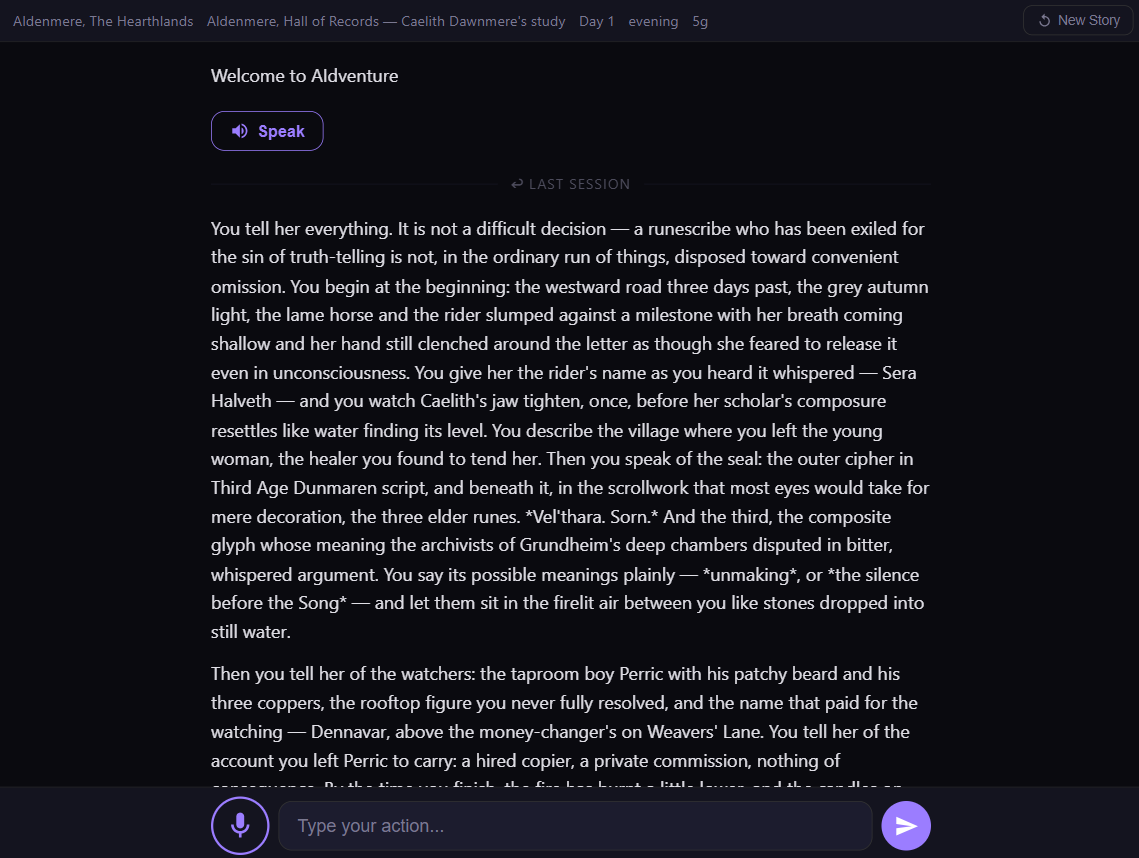
A small excerpt of a fantasy story from a Tolkien-like universe.
"You say yes, simply and without qualification, and something in Caelith Dawnmere's bearing shifts — not relaxes, precisely, for she is not a woman who relaxes whilst the world lists toward ruin, but settles, as a keystone settles when the arch is at last complete. She turns back to the hearth, takes up a small iron poker, and stirs the coals to brighter life. Then she begins to speak, and for the better part of an hour the fire burns and the candles shorten and the chronicles lean patiently in their towers around you, and you learn things that the Elders of Grundheim would have sealed behind three iron doors and a binding-oath."
I find that pretty good. Over time the style gets a bit tiring—everything is embellished in detail with sometimes somewhat far-fetched metaphors. But overall it reads well, sometimes exciting, and sometimes the AI even draws a chuckle from me.
2. Why amber? Why tuning forks? Why?
I can’t stand amber anymore. Amber-colored eyes. Amber light in the evening, amber-colored gates. Amber everywhere. What does the AI find so exciting about amber?
Here are a few ambers...
+ The great oaken doors stand ajar, warm amber light spilling out between them onto the rain-slicked cobblestones.
+ The amber warmth of the Hall's open doors is only a dozen paces away
+ but there is a light below — thin and amber
And tuning forks. Tuning forks and resonances. The AI has developed a real obsession with tuning forks and mysterious resonances. Carefully read every prompt, excluded everything that might suspiciously provoke amber or tuning forks. No change. Claude likes amber. Claude likes tuning forks.
3. Epic Fails
Every now and then the AI botches its metaphors horribly; you can tell: it doesn’t really know how our world works.
My favorite example:
“You have been the receiver since before you understood what the word meant or why your teeth ached on long car journeys through certain geological formations, why you always knew which way was down even in windowless rooms, why your mother looked at you sometimes ...“
Yes, it truly is a special gift to know where down is, even in the dark.
Also nice:
"Then she breaks the grey seal — it crumbles with a faint sound, the faintest sound, like a sigh held for three days"
Why a sigh after 3 days is quieter than before is hard for humans to grasp.
4. The appeal of “my” story
The most unexpected effect on me that listening to/playing such stories had was that it’s of great value to know: only I am hearing this story. The AI invented it just for me. If I click “New Story,” it’s gone forever; no one will find out how it continues.
Up to now I was sure the novel world will—similar to, say, carpentry products—split up so that for very little money, maybe 1 euro, you can buy an AI-generated, pretty good book, or for more money, maybe 10 euros, a book written by a real human, someone of my species with a similar emotional world as me. Like Ikea vs. a custom table.
But it could turn out very differently. Namely, that human books are “off the shelf.” Everyone reads the same new Sanderson, Fitzek. In contrast, in AI-generated books you can specify themes (“I want a fantasy book in a world of highly intelligent toads”). And you can influence the course of the plot in a much more flexible way than an interactive book or an Infocom adventure ever could.
5. Patience.. and budget…
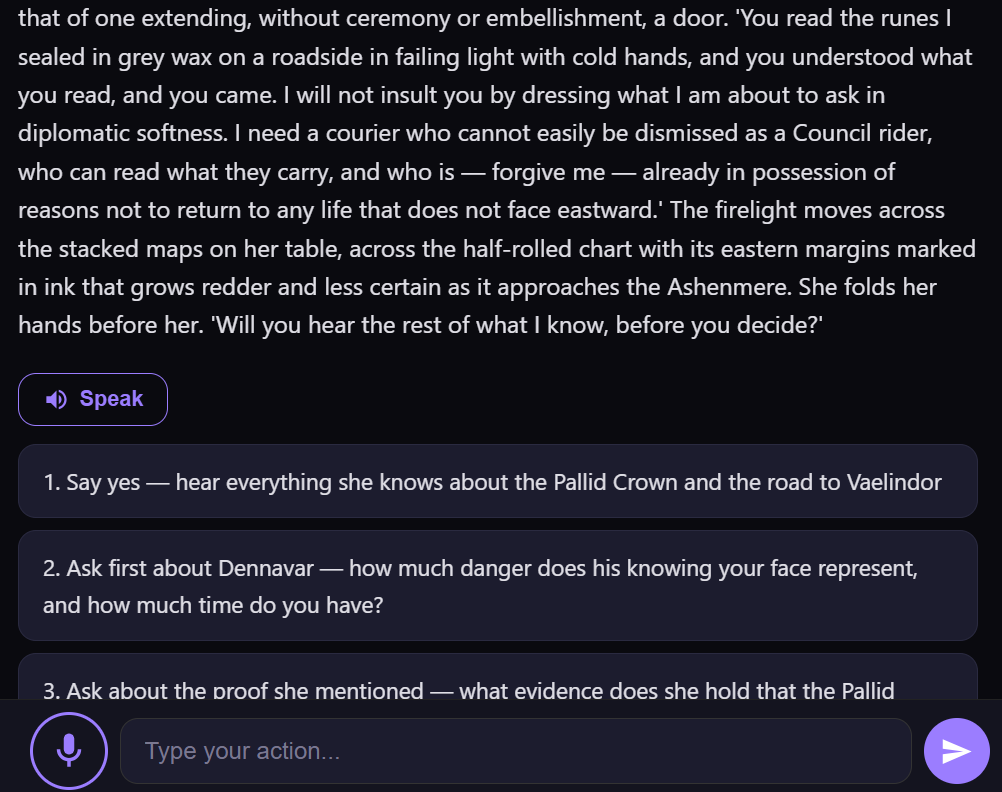
But what I needed most of all was a lot of patience, and a lot of money. My app generates the world with all characters, all places, the lore, … with Claude Opus 4.6; in the “game loop” Sonnet 4.6 provides the texts and the progress of the story. Also, I find it nicest to listen to the stories as an audiobook—spend more money on ChatGPT’s speech synthesis capabilities.
At first I tried it only with Opus—always take the best you can get—but with that you quickly end up at $10. But even in combination with Sonnet, a normal audiobook is much cheaper than the estimated 2 dollars per hour. In that time I send the AI 500,000 tokens, it sends back almost 100,000 tokens. It adds up.
But that’s the problem: either tell a long story consistently and send the whole story along with every request, or compress, condense, cut off and risk the AI losing the thread. Caching can save costs, but not solve the problem.
And now?
I’m curious how the story of AI stories will develop. For me personally: will I manage to bring more variation into the writing style? In general: will such interactive stories ever become a thing? I already find them unexpectedly worth reading. And we’re only at Claude 4.6, in the year 2026.
It remains exciting.